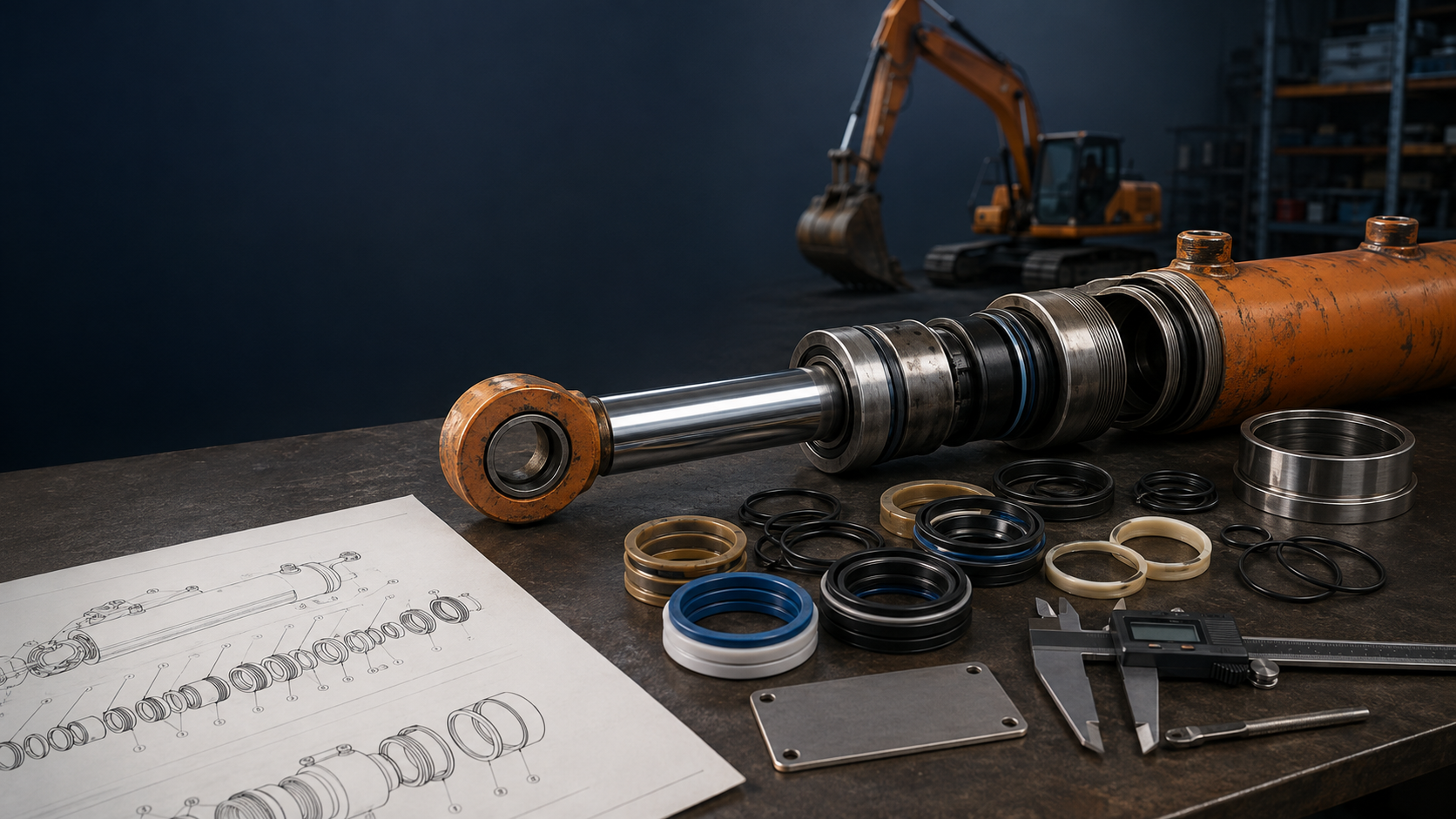

Short answer: Correct hydraulic cylinder seal installation requires the right kit, clean components, damage-free grooves, compatible lubricant, correct seal orientation and controlled assembly. A new seal kit cannot compensate for a scratched rod, worn bore, damaged groove or unresolved side load.
This guide covers general replacement procedures for rod seals, piston seals, wipers, O-rings, backup rings and wear rings used in construction-machinery hydraulic cylinders. Always follow the machine and cylinder manufacturer's repair instructions, torque values and safety procedures.
Before Disassembly
- Park the machine securely, lower attachments and isolate stored hydraulic energy.
- Confirm the machine model, serial range, cylinder position and seal-kit part number.
- Record hose positions and cylinder orientation before removal.
- Prepare clean plugs, lint-free cloths, compatible assembly fluid and non-sharp seal tools.
If the part number is unavailable, use our seal-kit identification guide and measurement guide before ordering.
Hydraulic Cylinder Seal Installation Steps
1. Clean and inspect the cylinder
Clean the exterior before opening the cylinder. After disassembly, remove oil, particles and old seal fragments from the gland, piston and grooves. Inspect the rod for scoring, corrosion, chrome damage or bending. Inspect the bore, gland, piston, threads, ports and groove edges. Burrs and sharp edges can cut a new seal during assembly.
2. Compare the old and new components
Lay out the replacement components without stretching them. Compare profile, inside diameter, outside diameter, width and material. A kit can contain visually similar O-rings or backup rings that serve different grooves. Do not identify position by appearance alone.
3. Record seal orientation
Pressure seals must face the correct direction. Photograph the old arrangement before removal if it appears original. Rod seals normally retain fluid inside the cylinder, piston seals separate pressure across the piston, and wipers face outward to exclude dirt. Follow the cylinder drawing when available.
4. Protect edges and threads
Use an installation sleeve or smooth protective film over threads, ports and retaining-ring grooves. Never drag a sealing lip across an unprotected sharp edge. Avoid screwdrivers, picks or metal levers with sharp corners.
5. Lubricate with a compatible fluid
Lightly lubricate seals and metal surfaces using clean operating fluid or a lubricant confirmed compatible with the seal material. Do not assume every grease is suitable for NBR, HNBR, PU, PTFE or other compounds.
6. Install static seals, wear rings and dynamic seals
Install each component in the documented sequence. O-rings must not be twisted. Split backup rings and guide rings must sit fully in their grooves. Fold rod seals only as much as necessary and allow them to recover. Expand piston seals evenly; PTFE or stiff profiles may require sizing or calibration tools.
7. Install the wiper correctly
A snap-in wiper should be fully seated. A press-in wiper should be installed with steady, square pressure and an appropriate tool. Hammering can distort the case, lip or housing.
8. Reassemble and test
Keep subassemblies covered and clean. Apply specified torque values, reconnect the cylinder, fill or bleed the circuit as required and begin testing at low pressure and low speed. Check for external leakage, abnormal friction, drift, noise and temperature before returning the machine to full load.
Common Installation Mistakes
- Ordering by machine model without confirming cylinder position or part number
- Reversing a rod seal, piston seal or backup ring
- Installing over exposed threads or burrs
- Using an incompatible lubricant
- Mixing components from different kits
- Reusing damaged wear rings
- Testing immediately at full pressure
Frequently Asked Questions
Can hydraulic cylinder seals be installed without special tools?
Some flexible seals can be installed by hand, but closed grooves, stiff PTFE profiles and press-in wipers may require dedicated tools. The correct method depends on seal design, material and housing geometry.
Should every old component be replaced?
Replace the components specified for the repair and inspect all mating hardware. Reusing a worn guide ring or damaged backup ring can shorten the life of new pressure seals.
Why does a newly rebuilt cylinder still leak?
Possible causes include incorrect orientation, installation damage, the wrong kit, contaminated oil, scratched hardware, excessive clearance, side load or a hydraulic-system fault. See our seal failure guide.
Need help confirming a kit before installation? Contact Fujis Seal with the machine model, cylinder position, part number, photos and dimensions.
Technical note: This is general information, not a substitute for the equipment manufacturer's service manual or work by a qualified hydraulic technician.