
Quick answer: The most reliable way to identify the correct excavator seal kit is to match the exact hydraulic component and OEM part number—not the machine model alone. Confirm the excavator brand, full model, serial number, cylinder position, cylinder or seal-kit number, and any production break. If the number is unavailable, measure the rod, bore, grooves and old seal profiles before ordering.
A seal kit that looks similar can still be wrong by a small dimensional or material difference. That can cause immediate leakage, internal bypass, seal extrusion or premature failure. This guide explains what information to collect and how to verify it before purchasing a replacement kit.
What information identifies an excavator seal kit?
Collect as many of the following details as possible:
- Excavator manufacturer and complete model designation
- Machine serial number or product identification number
- Hydraulic component: boom, arm, bucket, blade, steering, center joint or track adjuster
- OEM seal-kit number or complete cylinder assembly number
- Cylinder manufacturer and identification-plate information
- Rod diameter, cylinder bore and groove dimensions
- Photos of the machine plate, cylinder, old seals and seal arrangement
- Operating temperature, pressure, fluid and contamination conditions
The best match uses several identifiers together. A machine model is a useful starting point, but it is rarely enough on its own.
Why the excavator model alone is not enough
One excavator model can use different cylinders according to production year, serial-number range, regional specification, attachment configuration or supplier revision. A repaired machine may also have an aftermarket or replacement cylinder that no longer matches the original parts book.
Always state the cylinder position. “Seal kit for a PC200 excavator” is ambiguous; “bucket-cylinder seal kit for a PC200-7, with the cylinder assembly number and machine serial number” is much more reliable.
| Information | Reliability | How it helps |
|---|---|---|
| OEM seal-kit number | Very high | Directly identifies the service kit when the number is current and the cylinder is original. |
| Cylinder assembly number | Very high | Allows the cylinder version to be cross-referenced with its correct sealing set. |
| Machine serial number plus cylinder position | High | Helps resolve production breaks and regional variations. |
| Machine model only | Medium to low | Narrows the search but may leave several possible cylinders. |
| Old seal dimensions and profiles | High when measured correctly | Useful when part numbers and plates are missing. |
| Photo of the machine only | Low | Usually cannot confirm the internal cylinder design. |
Step 1: Record the complete machine identity
Photograph the excavator identification plate and record the brand, full model, serial number and production year if known. Keep all suffixes and hyphens. A suffix can identify a different series or hydraulic configuration.
If you are shopping by brand, start with the relevant collection, such as Caterpillar excavator seal kits, Komatsu excavator seal kits or Hitachi excavator seal kits. Then narrow the results using the OEM reference and cylinder position.
Step 2: Identify the exact hydraulic component
Determine whether the kit is for the boom, arm, bucket, blade, steering or another cylinder. Center-joint, travel-motor, main-pump and track-adjuster kits use different sealing arrangements and must not be treated as ordinary hydraulic-cylinder kits.
- Boom cylinder: raises and lowers the boom.
- Arm or stick cylinder: moves the dipper or arm.
- Bucket cylinder: curls and dumps the bucket.
- Blade cylinder: operates the dozer blade on compact machines.
- Center joint: transfers hydraulic flow between the upper and lower structures.
- Track adjuster: maintains track tension through the recoil assembly.
For a backhoe application, browse the appropriate range, including John Deere backhoe loader seal kits.
Step 3: Find the OEM seal-kit or cylinder number
Check the parts manual, dealer quotation, maintenance record, original packaging and cylinder plate. A number stamped on a seal may identify the seal manufacturer, material or size rather than the complete service kit, so do not assume every visible marking is an OEM kit number.
If you have a cylinder assembly number but not the seal-kit number, send the complete number without deleting prefixes, spaces or suffixes. Also tell the supplier whether the cylinder is original, rebuilt or aftermarket.
Step 4: Check serial-number and production breaks
Parts catalogs may list one seal kit before a particular serial number and another after it. Confirm which side of the production break applies. If the cylinder has been replaced, the number on the cylinder itself should take priority over the original machine specification.
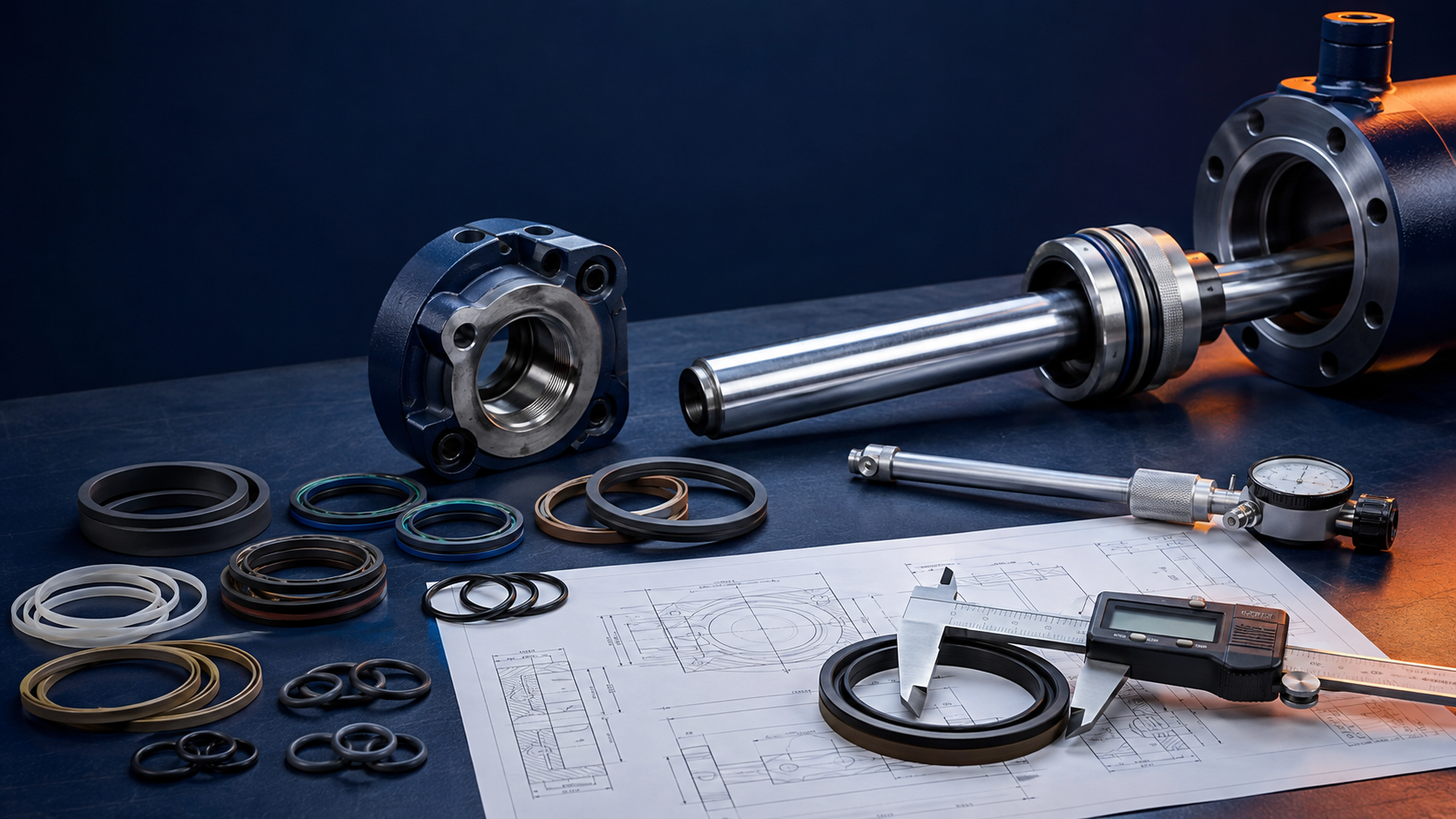
Step 5: Measure the cylinder and old seals when numbers are missing
Disassembly and measurement should be performed by a qualified hydraulic technician after the system is isolated and all stored pressure is safely released. Clean the parts before measuring and use calibrated calipers or micrometers.
| Measurement | What to record | Common mistake |
|---|---|---|
| Rod diameter | Outside diameter of the chrome rod | Measuring over damage, plating buildup or contamination |
| Bore diameter | Internal cylinder-barrel diameter | Confusing piston diameter with the nominal bore |
| Seal inside and outside diameter | ID and OD in millimetres or inches | Measuring a worn or distorted seal as if it were new |
| Seal height | Axial width of the seal | Compressing soft material while measuring |
| Groove dimensions | Diameter, width and depth | Ignoring wear or damage in the groove |
| Seal profile | Cross-section orientation and lip design | Matching by colour alone |
Photograph the complete seal arrangement before removing each component. Lay the seals out in installation order and include a scale in close-up photographs. Never select a replacement only because its colour resembles the original.
Step 6: Confirm seal material and operating conditions
Dimensions establish fit, but material affects performance. Hydraulic-cylinder kits commonly combine polyurethane, nitrile rubber, PTFE, backup rings and wear rings. Temperature, pressure, fluid compatibility, rod speed and contamination determine whether a material is appropriate.
- PU: commonly used for wear-resistant rod and piston sealing.
- NBR: widely used for hydraulic-oil-compatible O-rings and static seals.
- PTFE: provides low friction and is often used with an energizing O-ring.
- FKM: may be selected for higher temperatures or particular fluid requirements.
Material names alone do not confirm interchangeability. Profile, hardness, compound formulation and groove design must also match.
How to identify a hydraulic breaker seal kit
A breaker kit should be selected from the manufacturer and complete model shown on the breaker attachment—not from the carrier excavator model or tonnage. Record model suffixes and revisions, then compare the stated kit contents. Browse the hydraulic breaker seal kit collection for model-specific options.
Final verification checklist before ordering
- Is the manufacturer name correct?
- Did you record the complete model and serial number?
- Did you specify the exact cylinder or hydraulic component?
- Is the OEM number a seal-kit number or a cylinder assembly number?
- Have you checked for serial-number breaks and updated part numbers?
- Does the product description name the same application?
- Have you compared the photos and kit contents?
- Are the material and operating conditions compatible?
Frequently asked questions
Can I order an excavator seal kit using only the machine model?
Sometimes the model narrows the search to one result, but it is not reliable for every machine. Confirm the cylinder position, serial number and OEM reference whenever possible.
Is the cylinder number the same as the seal-kit number?
No. A cylinder assembly number identifies the complete cylinder, while a seal-kit number identifies its service sealing set. A supplier may cross-reference one from the other.
What if the cylinder identification plate is missing?
Use the machine serial number and parts manual first. If the cylinder has been replaced or cannot be identified, measure the rod, bore, grooves and old seals and provide clear photographs.
Can two cylinders with the same bore use the same seal kit?
Not necessarily. They may have different rod diameters, groove dimensions, gland designs, seal profiles or materials.
Should I reuse an old seal to choose the material?
Use the old seal as evidence, but remember that heat, oil and wear can change its colour, hardness and dimensions. Confirm the operating conditions and original specification.
What should I send Fujis Seal for identification help?
Send the manufacturer, full machine model, serial number, component position, OEM or cylinder number, photos and any available measurements. Email cmx@fujis-seal.com or contact Fujis Seal. For faster review, keep all numbers visible and state whether the cylinder is original or aftermarket.
Summary
Identify the cylinder before selecting the kit. Start with the OEM kit or cylinder number, confirm the machine serial range and exact hydraulic position, and use accurate measurements when identification data is unavailable. Combining these checks reduces ordering errors, repeat repairs and equipment downtime.
Manufacturer names and part numbers are used for identification purposes only. Unless a product listing states otherwise, products are aftermarket replacement parts and are not represented as being manufactured or endorsed by the original equipment manufacturer.